
Ancient Monuments of Kashmir

by Ram Chandra Kak


ARCHITECTURAL  STYLES


EARLY BUILDINGS (CIRCA A.D. 200 TO 600)

No structural monuments which can, with certainty, be said to belong to the pre-Christian era have yet been discovered in Kashmir. Even the first six centuries A.D. are very meagrely represented; the only monuments which can with certainty be assigned to the Kushan period being the Buddhist structures at Harwan and Ushkar.

The abundance in which the coins of Indo-Greek, Parthian, and Saka kings of north-western India were found until recently in Kashmir points to the existence of considerable commercial intercourse, if not actual political connection, between the valley and the principalities of Peshawar and Kabul in the last two centuries B.C. and the first century A.D. It is also certain that in the second century A.D. Kashmir formed part of Kanishka's empire and that, for at least some generations after the death of that emperor, the country remained attached to the kingdom of Gandhara. This long connection with the north-west of India has left an indelible mark upon the character of the Buddhist and Hindu architecture of the valley. The early Buddhist religious edifices of Kashmir have practically the same plan, and probably had the same elevation, as the contemporary Buddhist buildings of Gandhara. There was, however, a considerable difference in the materials used and in the modes of decoration. At Ushkar, for instance, the abundance of local quarries ensured a plentiful supply of stone chips, which the builders turned to excellent advantage. At Harwan, on the other hand, the most easily available building materials are the round boulders and pebbles brought down by the Dachigam Nala. Here accordingly we find the chip-masonry of Ushkar replaced by walls built of small pebbles (Plate XVII). The endeavour in each case seems to have been to employ building materials which were as small in size as possible. Probably it was thought that the merit accruing to the donor of a religious structure was commensurate with the amount of labour and care bestowed upon it. But this method carried to excess was bound to lead to disaster. The masons of Harwan, at any rate, seem to have realised early that a pebble wall built in mud, each pebble being not more than one or two inches in diameter, even though it was covered by a coat of plaster, was not a durable structure. In fact, to keep it standing for even a short period was not easy without vigilant care and constant repairs, for every shower of rain was certain to peel off a part of its facing. They therefore adopted the practice of inserting large stones in the midst of pebbles, thereby giving it a somewhat more solid and certainly more picturesque appearance (Plate XIX). This may be called the "diaper-pebble" style. The large apsidal temple at Harwan is built of this kind of masonry. It is, however, worthy of note that in this temple the diaper-pebble facing was covered with a revetment of beautiful and elaborately moulded bricks, some of which are still in situ on the enclosure wall.

This style was followed at Harwan by the diaper-rubble masonry (Plate XVI), which is represented by a large stupa, its surrounding walls, and chapels. The discovery of a coin of Toramana underneath the stairs of the stupa fixes its date, and consequently also the style in which it is built, as that of the sixth century A.D. or later. This kind of masanry is also found in a building at Parihasapura, where it may possibly be nearly contemporary with the buildings of Lalitaditya (eighth century A.D.).

MEDIAEVAL ARCHITECTURE (A.D. 600 TO 1300)
BUDDHIST BUILDINGS

We now come to the well-known and much described architecture of mediaeval Kashmir. It may be said with a fair amount of accuracy to begin at about the sixth to seventh centuries A.D. It ended with the transfer of the kingdom from Hindu to Muslim hands in A.D. 1337, though probably small monolithic shrines, such as those of Patan (Plate LVII) and Koil, continued to be consecrated even after that time. The buildings which represent this style may conveniently be divided into two classes - namely, the Buddhist and the Brahmanical. In point of materials, ornament, and technique, there is practically no difference between the two, but the religious needs of the two communities being in certain essentials different, they differ widely in plan and elevation. The Buddhists, who inherited a long artistic tradition, naturally adhered to their old models, though they employed better materials and somewhat elaborated the decoration. The material brought into use was a beautiful grey limestone, which was easy to carve, and presented a very smooth surface when properly dressed. The plinth of the old stupa, which was a simple rectangular structure with a single flight of steps, was now elaborated into a square with one or more offsets on each side projecting far into the courtyard (Plate LV), and flanked on either hand by side walls adorned with sculptural reliefs. The plinth in the larger buildings consisted of a double terrace, each comprising five courses of finely chiselled stone blocks of great size. The two lowest courses and the fourth course were plain, the third was fashioned into a round torus moulding, and the topmost into a filleted torus or cyma recta. The re-entering angles of the offsets afforded a pleasing contrast of light and shade.

As there is not a single stupa of which the drum remains intact, it is difficult to say precisely what its external decorations were.

Of the monasteries there is little to be said, as only one example survives - namely, the Rajavihara of Parihasapura. In plan it is a cellular quadrangle facing a rcctangular courtyard. The cells were preceded by an open verandah. In the middle of one side was the flight of steps which afforded an entrance and exit. The central cell on this side served as the vestibule. In the range of cells on the opposite side are a set of more spacious rooms which served either as a refectory or as the abbot's private apartments. Externally, and probably internally also, the walls were plain. The roof was probably sloping, and gabled like modern roofs in Kashmir.

Parihasapura has also bequeathed to us the only surviving example of a Buddhist chaitya, or temple. It is a square chamber built upon a square base similar to that of the stupa, save for the offsets and three stairs, and is enclosed by a plain wall, with entrance facing the temple stairs. The stairs lead up to the portico which gave admission to the sanctum. The latter was an open chamber surrounded on all sides by a narrow corridor which served as a circumambulatory path. At the four corners of the sanctum are bases of pillars which no doubt held some sort of screen designed partly to conceal the Holy of Holies from profane eyes. As the external wall of the corridor has been almost razed to the ground, it is very difficult to say whether there were openings in it for admission of light and air; probably there were.

The portico was covered by a massive trefoil arch, which in its turn might have been surmounted by a pedimental roof. The roof of the shrine was probably pyramidal like that of contemporary Hindu temples. At any rate, its plan would easily admit of such a roof.

HINDU BUILDINGS

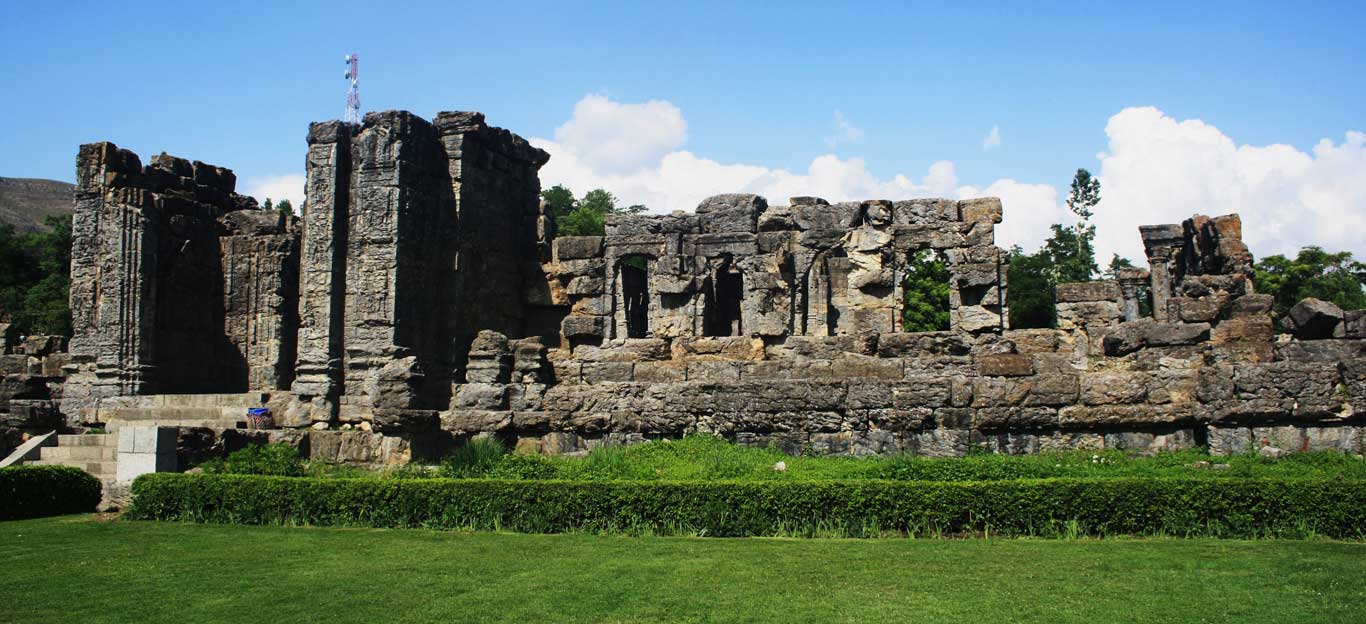
The second and far most numerous group of buildings belonging to this style are Hindu temples. The earliest example of this class, the date of which can be fixed through archaeological as well as literary evidence, is the temple of Martand (Plate LIII), which is also the greatest and one of the most finished of all the Kashmir temples. From this, however, it must not be inferred that the mediaeval Hindu architecture of Kashmir was born like Athene in panoply fully accoutred and complete to the last detail; that, in other words, it was evolved by a single brain or set of brains at a specified point of time. It is true that, owing to the remarkable dearth of early dated examples, we are reduced to mere conjecture as to what was the prototype, and what were the stages of evolution which resulted in such magnificent products of the builder's art as the Martand and Avantisvami temples (Plates LIII, XLVIII, and XLIX). But it seems reasonable to presume that the earlier examples were simpler, and that art progressed step by step, up to a certain point, from the simple to the more elaborate.

We have briefly noticed above the extent and depth of the influence of the Buddhist art of Gandhara on that of Kashmir. So great was it that it would be more correct to say that, excepting the natural and unavoidable difference in the material used, the two are practically identical. Though the religious needs of the Hindus did not necessitate their borrowing stupas and sangharamas from the Buddhists, such considerations did not lie in the way of their taking advantage of the experience the latter had gained in temple-building. The needs of the two communities were the same in two respects: a chamber was required for installation of a divine image (whether of the Buddha and the Bodhisattva or of Vishnu and any other Hindu deity is of little importance), and accommodation was required for worshippers. It is of course not impossible for a new religion to commence an architecture of its own, but the chances are overwhelming in favour of its utilising, at least in the initial stages, the older models, and adapting them to its purposes. This may not always hold good in the case where the new religion follows in the wake of foreign conquest and the conquerors have already evolved a style of their own, which they naturally wish to impose upon the vanquished. But when the new religion, like the old, is indigenous; when both live in mutual amity and exchange of good offices; and, lastly, when the mode of worship of both is practically the same, it becomes almost inevitable that the sacred buildings of the new religion should follow the style of those of the older one. This, at any rate, has happened twice in Kashmir, once when Buddhism slowly and gradually gave way to Hinduism, and again when, with the accession of Shah Mir, Islam, at first imperceptibly, but with increasing speed, supplanted Hinduism in the valley.

Regarding the first transformation, the similarity pointed out by Foucher between the "angular roofed" vihara (le Vihara d toit anguleux) of Gandhara and the temples of Kashmir, particularly the larger temple at Loduv (Plate XLVII), is specially interesting and instructive. The latter is an extremely plain structure, circular in plan internally, square externally, very simple in construction, and almost devoid of decoration. It has a single opening, the entrance, which is arched at the top. The arch is semicircular and built of horizontal projecting courses. The few stones of the roof which still exist prove that it was steep, straight, and sloped. The stones of which it is built are comparatively small in size. This is a curious feature, considering that the quarry which probably supplied the gigantic blocks of the Avantipur temple, and from which stones of immense size are still taken, is little more than a stone's throw from the shrine. This may be merely coincidence; but, taking it in conjunction with the simplicity of its design, it seems probable that the temple belongs to the time when the great possibilities of ashlar-dressed limestone began first to dawn upon the architects of Kashmir - that is, to the sixth or seventh century A.D.

This hypothesis is strengthened by the striking resemblance of the Loduv (Plate XLVII) temple to the vihara of Guniyar in the Swat valley. The dcscription of the former which has been given above would literally apply to the latter but for a few minor differences, which are: in the Guniyar example the plainness of the cella is relieved internally by four recesses placed diagonally; the row of projecting brackets which support the eaves of the roof are replaced at Loduv by a simple cornice consisting of three courses of projecting filleted blocks; on the other hand, there is no trace of a pediment over the entrance of the vihara. These details, however, do not impair the analogy between the two. Now the Guniyar structure cannot possibly be later than the fifth century A.D., and unless there is something positive to prove the lateness of the Loduv temple (to my knowledge there is nothing), we must on the strength of the reasons adduced above consider it either contemporaneous with the former, or at most a century or so later.

A structure of which thc date has caused much controversy is the Sankaracharya temple (Plate V) on the Takht-i-Sulaiman hill. General Cunningham, relying mainly upon local tradition, assigned it to Jalauka, son of Asoka, whom he puts about 220 B.C.

Professor Buhler denies the existence of this tradition, but does not himself give any definite opinion. Mr. Fergusson rejected Cunningham's view chiefly on grounds of style. He remarks: " At the bottom of the steps is a round-headed doorway, not, it is true, such as is universal in the Hindu imitations of Muslim architecture in the seventeenth and eighteenth centuries. The same is the case in the small temples alongside, which are evidently of the same age. The one most like it that I am acquainted with is that erected by Chait Singh of Benares (1770-1781) at Ramnagar at the end of the eighteenth century. I know of no straight lined pyramid of much older date than that, and no temple with a polygonal plan combined with a circular cell, as is the case here, that is of ancient date. The ceil itself with the linga is undoubtedly modern, and the four pillars in the cell with the Persian inscriptions upon them are avowedly of the seventeenth century. It is suggested, moreover, that they belong to a repair. My own conviction, however, is that the temple, as it now stands, was commenced by some nameless Hindus in honour of Siva during the tolerant reign of Jahangir and that the building was stopped at the date engraved on the staircase, A.H. 1069 (A.D. 1659), the first year of Aurangzeb. It was then unfinished, and has remained a ruin, and this may have given it an ancient appearance, but not such as to justify putting its date back 1870 years."

Sir Aurel Stein is inclined to accept the opinion of Fergusson, at least so far as the superstructure is concerned. He states that " the circular cella, which contains a modern linga, was undoubtedly built in Muslim times. The imposing polygonal base, consisting of remarkably massive blocks and without mortar, must belong to a much earlier period (Plate LXXIV). Whatever may be the date and origin of the temple on the Takht hill, its connection with the worship of Jyestharudra is highly probable.''

Cunningham's theory, which was based on the traditional identity of the temple with the temple of Jalauka, lost all basis when the existence of that tradition was questioned and disproved. Fergusson's arguments in support, on the one hand, of his rejection of Cunningham's view and, on the other, of the plausibility of his own, are equally untenable for the following reasons:

1. True round-headed arches of the early Hindu times are known in India; and the existence, therefore, of a horizontal round-headed arch in a Hindu temple does not necessarily imply its late date and imitation from Muslim models. At Loduv we have a similar arch.

2. Whatever the value of his assertion that he did not know of any straight-lined pyramid much older than the eighteenth century, nor any " temple with a polygonal plan combined with a circular cella," his deduction from it is invalidated by the fact that the Sankaracharya temple is not a straight-lined pyramid in the sense which his words seemingly imply, and that its plan is not polygonal. Its walls rise straight up to the eaves, and its roof, the lowest course only of which is extant, was triangular in section like the roofs of other ancient temples in Kashmir. In plan the cella is externally square, with a couple of offsets on each side.

3. Though the pillars in the sanctum bearing Persian inscriptions are modern and were probably put up in Shah Jahan's time, it does not seem that they alter the position in any way, for the ancient domical ceiling built of concentric circles of kanjur masonry is still in existence above the modern ceiling.

4. Lastly, his conviction that it was begun by some nameless Hindus in Jahangir's time and was left incomplete after the accession of Aurangzeb in A.D. 1659, " which gives it its ancient look," is flatly contradicted by Bernier, who saw it in A.D. 1664, only five years later, and states that it was in ruins and desuetude. Catrou, whose General History of the Mughal Empire was published in 1708, only one year after Aurangzeb's death, ascribes it to Solomon. This shows that its origin was even then unknown, which would scarcely be the case if its construction had been taken in hand in the time of Jahangir and stopped by Aurangzeb's order.

Rai Bahadur Daya Ram Sahni states that "the temple beIongs to the same mediaeval period as all the other buildings of this class,"which is probably correct. But his further remark, "that the enclosure wall of this temple represents a decadent form of the cellular peristyle," seems to imply that the smallness (that is what he probably means by decadence) of the peristyle necessarily connotes a late date, and that consequently the Sankaracharya temple is later than those temples which have larger peristyles. Now there are several temples in Kashmir whose date admits of no doubt - e.g., the Martand, the Avantipur, the Patan, the Kother temples. The first belongs to the beginning of the eighth century A.D. and the last to the end of the eleventh century. But the lapse of the three centuries and more does not appear to have in any way influenced the dimensions of the peristyle, except of course in cases where the reduced size of the central shrine itself necessitated proportionate reduction in the dimensions of the peristyle also, and secondly where the nature of the site chosen for the erection of the temple did not permit of the construction of a large, or for the matter of that any, peristyle. The first, for instance, is the case in the two Patan temples which were built by Sankaravarman and his queen Sugandha at one and the same time. The Pandrethan temple which, I believe, belongs to the middle of the twelfth century A.D., but which according to Rai Bahadur Daya Ram Sahni " is certainly quite 200 years older," has a surrounding wall, but no cellular peristyle; this would be very strange indeed in a temple which so closely followed the Avantisvami temple (A.D. 852-855), if the peristyle were an indispensable adjunct to the early Hindu temples. As a matter of fact we know from extant examples that it was not. It has been established that the two larger temples, at Wangath were built by Lalitaditya, who built the Martand temple also. Of these three temples erected by the same king, one (Martand) has the largest peristyle known to exist in Kashmir, the second (Jyeshthesa at Wangath) has a comparatively small one, and the third (Bhutesa at Wangath) has none at all. Thus it seems to me that the smallness - the so-called decadence - of the peristyle, or its very absence, does not in itself afford any indication of the age of the temples.

From the foregoing remarks it will have been observed that though it may be indisputable that the Sankaracharya temple " belongs to the same mediaval period as all the buildings of this class," its proper position in the sequence of Kashmir monuments is by no means well established. Fortunately in this matter the temple itself comes to our aid. The salient features of the central shrine are the following: (1) externally it is square in plan with two offsets on each side; (2) internally it is circular; (3) the cella is absolutely without decoration both internally and externally; (4) it is pierced by a single narrow opening (the entrance) semicircular at the top and surmounted by a very shallow and steep pediment; (5) it stands in a narrow octagonal court which is enclosed by a low parapet wall adorned with rows of small niches. Of all the temples in Kashmir that to which it bears the closest resemblance, both in disposition of parts and in ornament (or rather the want of it), is the one at Loduv. Apart from the enclosure wall and the base, which are submerged in the swamps formed by the spring at Loduv, and which therefore are not available for comparison, the only difference between the two shrines is that the Sankaracharya has two offsets on each side externally, while the other has none. This certainly is an innovation and an improvement, since the light and shade of the re-entering angles of the offsets compares favourably with the baldness of the exterior of the Loduv temple. But it must be noticed that the offsets are severely plain. In this respect they stand in very marked contrast with other examples of mediaeval Hindu architecture. Not only do such undoubtedly late temples as those of Mamal and Kother possess more or less ornate trefoiled recesses on each side, but even the very latest miniature monolithic shrines, which were probably erected at the time when Hindu rule and Hindu art were at a low level, display these decorative features, sometimes actually carved out of the stone, as in the structural examples, or merely traced in outline. It seems, therefore, clear that the absence of such decorative features as attained currency in the eighth century is, in case of the Sankaracharya temple, an indication of its older age, and not a sign of decadence. In other words, though the Sankaracharya temple is somewhat later than the Loduv temple, it cannot be less than a century older than the Martand temple; that is to say, its approximate date is probably A.D. 700.

The octagonal enclosure is more a matter of accident than of design. It is due to the situation of the temple, which precluded the possibility of a larger enclosure of any other type without immense expenditure. But notwithstanding the fact that it is a great improvement upon the Loduv temple, there is a considerable gap from the Sankaracharya to the Martand which must have taken a good deal of time and invention to bridge over.

In accelerating progress, however, Lalitaditya's large resources and even-handed generosity to the Hindus and the Buddhists effectively came to the aid of the Kashmir architect. To the Buddhist the king's bounty brought no change. All that he did was to use better and more massive materials. He built a monastery of gigantic ashlar- dressed limestone blocks exactly as he would have built it of rubble stone and timber. The Hindu, on the other hand, used both his hands and his brain, with what result is evident to every one who has seen the wonderful ruins of the Martand temple. He did not invent many new forms of design and decoration. He simply re-arranged the motifs he had ready at hand into a new artistic combination which was so beautiful and at the same time so dignified that it fixed for all succeeding centuries of Hindu rule the ideal of what a temple of the Gods should be. He had already adapted a Buddhist temple for his purpose at Loduv; he had improved it by the addition of offsets at Sankaracharya; he had pierced the offsets with trefoiled niches at Narastan (Plate LII), which probably follows gankaracharya in date. The most important feature that still remained to be added was the cellular quadrangle. This he achieved at Martand.

Regarding the origin of the cellular quadrangle there can be little doubt. The Buddhist monastery from very early times consisted of a quadrangular block of rooms facing a common courtyard, in which usually stood a small private chapel. If the chapel was a large one and placed in the centre of the court, the plan would exactly correspond with that of the Martand or the Avantisvami temple, the former of which is contemporary with the Buddhist structures of Parihasapura. Of course, in the Hindu temples the size of the cells was considerably reduced, as they were no longer required for residential purposes, but merely for the accommodation of the images; the width of the promenade in front of the cells was also reduced in the temple; the columns which supported its roofs were now used for a purely decorative purpose, and sometimes, when the resources of the builders failed, were altogether given up; the unpretentious flight of steps, quite suitable for a congregation of religious mendicants, was replaced by a magnificent double-chambered entrance, almost equal in size to the temple, to make it a fit portal for an abode of the Gods. These and other details, as the necessity or the fancy of the artist dictated, were gradually added; but the broad outline of the ordinary Hindu temple of the best period remained the same - namely, a chaitya built in the middle of a monastic courtyard.

Latcr, when the Hindu rule lost its early vigour and the country was constantly torn by intestine warfare, the religious buildings of Kashmir gradually lost much of their impressive grandeur. Architectural features, such as the trefoil arch and the detached column, lost their original purpose and became mere decorative motifs. The dimensions of the temple gradually dwindled until they became small monolithic miniatures not more than 2 feet each way. The column was altogether given up. The arch became shallower and shallower. At Payar (Plate LI) it is merely a sculptured niche over the lintel of a rectangular doorway; at the Bumazu cave-temple only its outline has been shown; the small shrine in the Patan (Plate LVII) spring does not show it at all, though it still reproduces the elaborate double pediment and the moulded bases and capitals of the jambs. Thus, curiously enough, the principal features of both the beginning and the end of the mediaeval Hindu architecture of Kashmir are the absence of the structural trefoil arch and the colonnade, which would for the purpose of fixing their chronological sequences be confusing enough, were it not that other characteristics - such as the design, decoration, mouldings, etc., render it possible to distinguish one from the other.

The mediaeval architecture of Kashmir depended for its effect upon (1) the simplicity and unity of its design, (2) the masslveness of the blocks of limestone and granite that were used, (3) the finish of dressing, and (4) last but not least, the natural beauty of the site chosen for erection of the temple. Its main feature is a happy combination of the column and the arch.

(1) The temple was conceived as a single whole, and after its construction afforded little or no scope for subsequent additions. Its plan and disposition were apparent at a single glance. In this characteristic it differed essentially from the majority of Indian temples, which, whatever their beauty in detail, present when viewed as a whole a rather confused appearance.

(2) and (3). All the temples of Kashmir, except those of Wangath (Plate LXII) and Buniar (Plate LX), in which the material used is granite, are built of limestone, which the quarries of Loduv, Zewan, and Ajas plentifully supply. The blocks used are extraordinarily massive, often measuring 10 feet and more in length. The floor of the chaitya at Parihasapura consists of a single block approximately 14 x 12 x 6 feet. The blocks, before being placed in their proper position, were-only roughly dressed, the architectural decoration and sculptured reliefs being merely blocked out; the final dressing was done in situ. It was an inconvenient and somewhat circuitous method, but it was necessary, as otherwise the delicate carving, if not done in situ, might sustain grievous damage in handling. Lime mortar was undoubtedly used; but the stability of the masonry was sufficiently assured by the massiveness of the blocks, which had only vertical pressure to resist, there being no lateral thrust, owing to the absence of voussoir arches and the frequent use of iron clamps. There is reason to believe that this wealth of stone carving was covered by a coat of gypsum plaster, which was probably painted, and in which the more delicate details of sculpture and other decoration were finished off.

(4) A natural result of the pantheistic tendencies of early Brahmanism is the extraordinary reverence in which both the Buddhists and the Hindus have always held Nature. To them the wide prospect over the rolling plains, as at Ellura, or the wild grandeur of glaciers and eternal snows, as at Amarnath, or the view of a magnificent sunset over the hills, as at Martand, not only made a general aesthetic appeal, but had a special religious significance; for they viewed Nature as the multifold manifestation of the Almighty. It was for this reason that they invariably chose the most naturally beautiful spots for their sanctuaries. Much of the charm which the religious buildings of Kashmir undoubtedly possess is due to this fact. To take only one example: as the site of a temple, the conical summit of the Takht-i-Sulaiman hill, rising a thousand feet vertically above the surrounding plains and commanding a panoramic view of the entire mountain-girdled valley, would be difficult to rival anywhere. The temple seems the natural apex of the pyramidal hill. The steep sombre lines of the barren slopes blend insensibly with the still more sombre, grey, and vertical lines of the temple walls. Art has not only advantageously utilised, but also emphasised, the natural characteristics of the situation (Plate IV and Plate V).

PLAN. - In plan the Kashmirian temple (Plates LXVIII, LXXIII, and LXXV) is a rectangular quadrangle pierced with cells facing the courtyard. The temple usually consists of a single chamber with a portico, and is, as a rule, at the point of intersection of the diagonals of the courtyard. The entrance, which is almost equal in dimensions to the main shrine, is a double-chambered structure, and is built in the middle of a shorter side of the peristyle. The chambers are divided by a partition wall, which is open in the middle and was probably closed by wooden doors. The entrance has a double flight of steps, one external and the other facing the temple. The stairs are flanked with plain stone rails and sculptured sidewalls.

The main shrine consists, as has been stated above, of a single square chamber, preceded by a small portico (Plate LXV). Externally a facet is added on each side, which is hollowed out into a trefoil-arched niche; the front one, being open, serves as entrance to the sanctum. The temple stands on a single or double base which consists usually of five ashlar-dressed courses, the first, the second, and the fourth of which are plain and the remaining two moulded (Plate LXXIV, A, B, C, and D).

The cells of the peristyle also stand on a plinth which is similar to the base of the temple. The central cell on each of three sides is slightly larger than the rest, and is somewhat advanced beyond the line of the peristyle.

Some of the temples possess subsidiary shrines. They are usually built in an angle of the courtyard and are similar in plan to the main shrine (Plate LXVIII).

VARIATIONS IN PLAN. - The Loduv and the Sankaracharya temples are circular in plan internally. The former does not possess any facets externally, and in the latter they have not yet developed into trefoiled niches. The Payar and some other temples do not possess any cellular peristyle. The Narastan temple has a plain enclosure wall with a gateway of the conventional type. It has a small tank in front, and a bath chamber in one of the corners of the enclosure wall. The Sankaracharya temple has an octagonal range of miniature cells in its surrounding wall.

WALLS. - The walls are built of finely dressed and massive blocks of limestone. Mortar was used, though not in considerable quantities, as the stones were secured by iron clamps. The joints are usually very thin. The surface was often carved with sculptured reliefs, geometrical and floral patterns, but the internal surface of the walls of the cella was generally kept plain. The walls were surmounted by a sloping cornice, usually decorated with rows of geese alternating with rosettes and kirtimukhas (Plate LXX). Externally, the walls of the peristyle are plain, except in certain cases where a series of shallow projections marks the position of the crosswalls of the cells. Internally the pilasters of the cells are decorated with half-engaged columns carved in low relief (Plate LXXII).

OPENINGS. - Curiously enough there exist no traces whatever of any windows or skylights in any of the known temples of the valley. This is probably due mainly to the fact that the light and air entering through a single large doorway was enough for a small square cella. Still less was there any need for such apertures in the case of the cells of the peristyle. The only openings, therefore, that are found in the walls of the Kashmirian temples are the doorways. They were rectangular, surmounted by trefoil arches, and were usually preceded by trefoiled and pedimented porticoes. In the Loduv and gankaracharya temples, the entrances are round-headed.

Temples of the mandapa, or "bower" type, like the Pandrethan (Plate XLIV) and Payar (Plate LI) temples, being open on all four sides, have naturally four doorways; while temples of the vimana type, such as the Avantisvami temple, have only one entrance.

A large temple (Bhutesa) in the group A at Wangath has two doorways facing each other.

CEILINGS. - Ceilings of Kashmiri temples were of four types, or rather three only, the third being merely a variety of the second type.

I . The ceiling of superimposed diminishing squares. The plan of the cells being square, the architect chose the method of cutting off the angles as the easiest means of spanning it. The second square thus formed was further reduced by another series of four stone beams which rested upon the first four. This process was repeated until a single square stone of sufficient dimensions was found to span the whole gap at the top. The triangular spaces resulting from this construction were filled with carved figures of flying Yakshas, and the apex was usually decorated with a full-blown lotus flower. The best example of this kind of ceiling is in the temple at Pandrethan (Plate LXVI).

2. The domical ceiling. The dome rested upon a projecting string-course, and was built of kanjur or kanait, a light and porous limestone which burns into excellent lime. It was not built on the radiating principle, but consisted of a series of concentric circles of small blocks of kanjur held together by mortar of extraordinarily adhesive properties. The stability of the dome, in fact, depended entirely upon the tenacity of the mortar. The ancient architects probably constructed this dome much as a modern engineer would construct an arch of cement concrete. The two largest temples at Wangath have ceilings of this type.

3. The corbelled ceiling seems to have been a variety of the domical ceiling, the only difference being that in this case the dome instead of rising direct from the string-course is supported on an elaborate system of corbelled pendentives. The corbels could have also been used with great advantage in the ceilings of the first type, inasmuch as they were capable of sustaining a greater weight than the unsupported stone beams, and could more easily reduce the span of the space to be covered.

4. The fourth type may aptly be described as the " no-ceiling " type. The best known, perhaps the only, examples of this class are the buildings at Narastan and Naranthal. The walls of the cella are carried up vertically until they reach the level of the eaves. Therefrom the pyramidal roof itself forms the ceiling.

5. A small temple at Wangath and the detached room to the north-west of the Sankaracharya temple have flat ceilings of rectangular stone slabs resting on transverse stone beams supported by columns.

ROOFS. - The roofs are invariably pyramidal. In the examples which have survived - eg., the Pandrethan (Plate XLIV), Payar (Plate LI), and Manasbal (Plate LXI) temples, not to mention the miniature shrines at Patan (Plate LVII), Koil, etc. - the pyramid is a double one, the lower storey being truncated at about the middle of the roof, and a second one built on a projecting string-course. The apex of the pediments of the porches reaches up to the upper edge of the lower storey, and produces a pleasing effect of light and shade. The plainness of the upper pyramid is sometimes relieved by a miniature gabled trefoil niche (Plate XLIV) in the middle of each of the four sides. The apex of the roof, as well as that of the four pediments, was crowned with a ribbed melon-like finial. Two of these are extant at Payar (Plate LI).

The roof of the small temple at Naranthal consists of a single plain pyramid.

COLUMNS. - Perhaps the most striking feature of the Kashmiri temple is the majestic colonnade (Plates XLVIII, LIII, and LX) which surrounds it on all sides. The columns are either smooth or fluted, and at the angles of the peristyle they are square. They are composed of three separate parts: the base, the shaft, and the capital. The base is either a plain square block with the upper edge rounded off, as at Avantipur (Plate XLIX), or is elaborately moulded, as at Martand (Plate LIII) and elsewhere. The latter has been described by Cunningham thus: " The upper member is an ovolo with a straight fillet above, and the apophyge below. The next is a filleted torus, with a fillet above and below and surmounting the straight face or neck of the pillar. In the large Martand pillar the torus is plain. Beneath this is a quirked ovolo with a straight fillet above and below, and the last is the plinth. In all these the upper and lower members are of the same height; that is, the ovolo and the apophyge are equal to the plinth."

When the shafts are fluted the flutes are sometimes so shallow as to have scarcely any concavity. In some cases - for example, at Avantipur - the central portion of the flute is roughly chiselled, and is in strong contrast to the edges, which are finely dressed. In the columns of the Patan temples the flutes are well accentuated. The number of flutes in different examples is twelve, sixteen, twenty, and twenty-four; but never less than twelve nor more than twenty-four.

It is difficult to say whether or not the diameter of the columns was a factor in determining its height.

The capitals are square, voluted, or bracketed, and rest upon a ribbed astragal (Plate LXVII). The height of the capital is usually equal to the upper diameter of the column. The bracket capital is sometimes adorned with figures of Yakshas.

The inter-columniation of the Kashmir colonnade was about two-thirds of the height of the column itself.

The entablature consists of the architrave and the cornice. In the case of the peristyle, the architrave returns, connecting the pillar with the pilaster of the cell behind. Both the architrave and the cornice are decorated with rows of rosettes alternating with Kirtimukhas or grinning lions' heads (Plates LXX, A, and LXXIV, E).

ORNAMENT. - This consists of sculptured figures and geometrical and floral patterns which are mostly intermingled (Plates LXVII, LXX, LXXI, and LXXII). The most common motif of the former is the figure of a god or goddess standing in a pedimented niche (Plate LI and Plate LXIV). At Avantipur there are groups of figures of both sexes, engaged in drinking, making love, or other occupations (Plate L). The sculptured reliefs are principally found on the walls of the entrance and the flank walls of the stairs. It is probable, as stated above, that not only the plain wall surfaces but also the reliefs were covered with a fine coat of lime plaster, on which the addition of colour defined the more delicate details of decoration.

The principal mouldings (Plate LXXIV) employed are (1) cyma recta, (2) torus, (3) filleted torus, (4) ovolo, (5) echinus, and (6) fillet. None of these was enriched by any surface decoration, except in the case of the second, which was in a few examples adorned with broad, plain, slanting bands carved in bold relief.

MUSLIM ARCHITECTURE
(FOURTEENTH CENTURY A.D. AND ONWARDS)

It will have been remarked, from the short account of Kashmir history given above, that the transfer of the sceptre from the Hindus to the Muslims was a purely domestic matter, and had nothing to do with the great Pan-Islamic conquests of the twelfth and thirteenth centuries. It was, moreover, an entirely secular affair. Rinchana, who was the first non-Hindu to occupy the Kashmir throne, was a Tibetan, and became a Muslim by accident. Shah Mir's usurpation was a coup d'etat and not a conquest. He and his immediate successors depended upon the support of the indigenous nobles, who were mostly Hindus, for the stability of their rule. The absence from Kashmir of the regular Saracenic mosques with cloisters and domes is not therefore surprising. The Muslims in Kashmir were in the beginning far too few to initiate an architecture of their own. All that they did was to utilise the materials of disused Hindu temples for construction of their mosques. The result was peculiar. The most characteristic examples of this style are the mosque of Madin Sahib, outside the Sangin Darwaza of the Hari Parbat fort and its adjacent ruins, the ruins of the mosques on the roadside at Vitsarnag, and Zain-ul-abidin's mosque on the island in the Wular lake. All these will be described in detail below.

Another structure belonging to this period, and fundamentally different from all other buildings in Kashmir, is the tomb of Zainul-abidin's mother (Plate VIII). The plinth originally belonged to a Hindu or Buddhist shrine, and does not seem to have been tampered with by the Muslim architect, who simply followed the lines laid down by his Hindu predecessor. A peculiar feature of the brick buildings of this period (there are only three: the tomb of Zain-ul-abidin's mother, Madin Sahib's tomb, and the anonymous tomb on the island in the Wular) is the glazed tile-work with which they were decorated.

"The mosques and tombs of the modern Kashmiri style are so similar that their features need not be separately discussed. The tombs are square in plan. The mosques are either self-contained, square buildings like the tombs: such are the mosques of Madani, Shah Hamadan (where the cloisters were added later) (Plate VI), and the Jama' Masjid at Pampur (Plate XLVI); or else they consist of a group of square-planned buildijngs connected together by a colonnade like the Jama Masjid in Srinagar.

"The walls are constructed sometimes of bricks and mortar, sometimes of logs laid across each other, the space between logs being in some cases filled with brick-work. Piers are constructed of timber in the same way.

" In large chambers where the timbers of the roof or ceiling require intermediate support, modern columns are used with very good effect. Sometimes these columns are elaborately ornamented, and there is a tendency in modern restoration, as, for instance, at the mosque of Naqshband, to cover the bases with coarse and unsuitable ornament. Timber trusses do not seem to have been understood by ancient builders, but they are now employed in restoration. The old method of supporting the rafters was by building up piers formed of logs laid horizontally - a very extravagant arrangement. The typical roof covering consists of turf laid in birch bark, which retains waterproof properties for a great number of years. The birch bark is laid on boards, and these in turn are supported on rafters. The roof is usually surmounted by a steeple, the finial of which is moulded, the largest moulding being sometimes in the shape of an outspread umbrella usually covered with metal. All the older buildings appear either to have lost their steeples and finials, or to have had them restored. The oldest umbrella mouldings are probably some of those on the Jama' Masjid (Plate IX and Plate X) at Srinagar, erected in the reign of Aurangzeb.

"A remarkable feature in the steeple is the sloping gable which projects from the sides. Window openings and balustrades are commonly filled with elaborate jali screens, the patterns of which are formed by little pieces of wood fitted together so as to form geometrical patterns (Plate X).

" The angles of the eaves are generally ornamented with wooden pendants suspended from the corners, carved like small bells and shaped like cactus leaves. The cornices are very heavy, and are formed of logs corbelled out from the wall face on timbers laid crosswise. The butt ends of the cross timbers form a dentil course, and the space between them is filled with elaborate carving. The best examples are at the mosques of Madani at Srinagar and of Amir at Pampur.

" The interior of the mosque of Shah Hamadan is entirely covered with panelling consisting of geometrical patterns.

" The mouldings are as a rule flat, not deeply recessed, and curved and hollow members seem to be avoided. They generally consist of flat fillets, each of which is differently carved.

" The carved ornament is generally Saracenic in character. In older buildings the patterns are conventional. In some later restorations realistic flowers are carved, bearing much resemblance to the stone-work of Shah Jahan in the Taj at Agra and elsewhere.

" Of the Mughal style as exemplified by buildings in Kashmir it is not necessary to say much, because the style is practically the same as that with which we are familiar at Agra, Delhi, and Lahore.

. . . The Pathar Masjid (Plate VII), the mosque of Akhun Mulla Shah (Plate XII), and the largest barahdari in Shalimar Bagh (Plate XIV) are unsurpassed in purity of style and perfection of detail by any buildings in Agra or Delhi.

" Another important branch of architecture in which the Mughals excelled, and in which they left their mark upon Srinagar, is gardening. These gardens conform strictly to the style of Shalamar Bagh at Lahore and Delhi, and other gardens of the same period in India; but nowhere is there to be found a group comprising so many examples as at Srinagar.''


Kashmiri Overseas Association
 Kashmiri Monuments