
MANASBAL LAKE

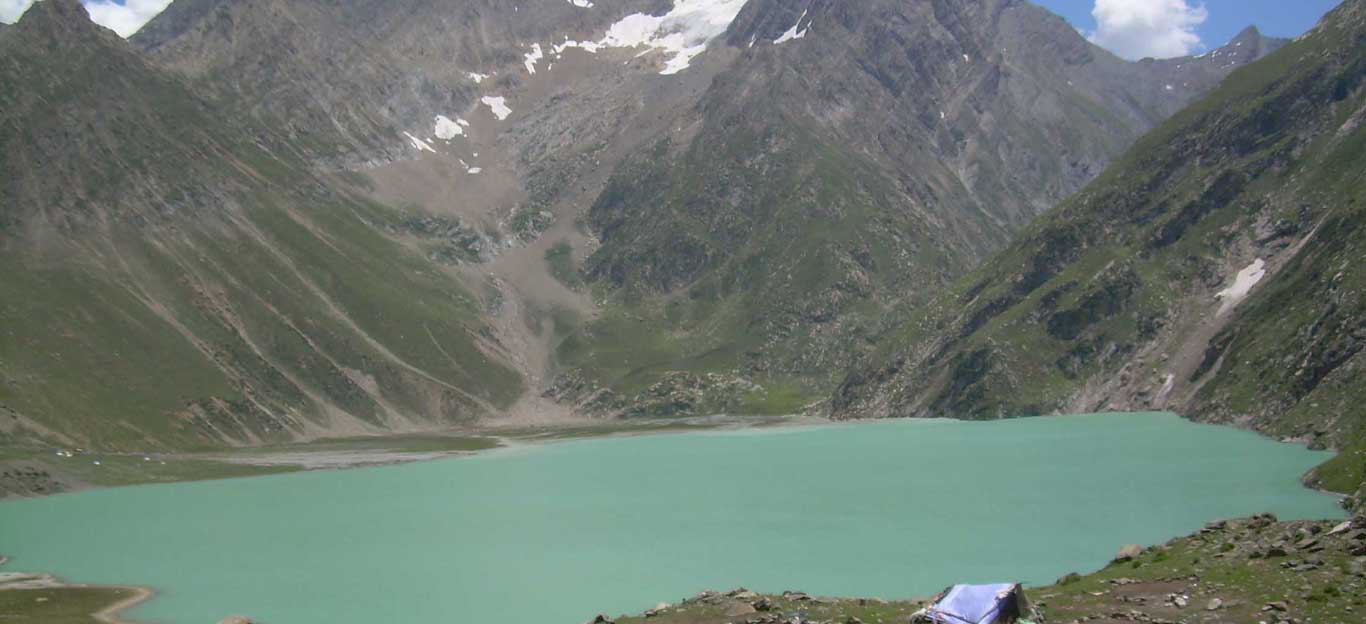
Manasbal is a delightful lake situated on the Jhelum Valley at a distance of 18 miles from Srinagar via Shadipor, and 17 miles via Nasim and Ganderbal road. The word Manasbal is derived from Manusarwar, the sacred lake which skirts the Kailash Mountain along with Gauri-Sar and Rakhas Talav. As it was very difficult for Kashmir Hindus to go on such a far-off pilgrimage, they satisfied their far-off pilgrimage, they satisfied their religious craving by naming the secluded sheet of green water Manasbal.

This is not the only instance of the derivation of geographical names in this manner. The shrine of Sharada up in the Northern mountains is several marches from Srinagar. In order to avoid the difficult journey to the shrine without losing the merit of a visit to it, the Brahmans of Srinagar have named a small spring to the north-east of the reservoir, Sharad Bal. The water of this spring contains medical properties and is highly digestive. It is under a huge chinar outside New Thid. Vitsar Nag which is five miles from Srinagar is called Ailapator after the lake to the west of Gulmarg.

A journey by a doonga house-boat occupies about six hours. The boat leaves the Chattabal Weir and glides downward propelled by two or more paddles. The passengers lounge leisurely in the boat, their eyes open to the sights which meet them from various directions. White vultures, crows and kites are seen feeding on floating carcasses, while kingfishers blue and pied are busy hovering over their prey. The holes in the river bank are made by these birds and deserted nests are used by sparrows and hoopoes. In April the river banks are gracefully carpeted with yellow-blossomed rape-seed fields and blue iris beds. It behoves lovers of colours to attire themselves in yellow, eat yellow-coloured rice and sit and observe the play of colours under a peach-blossomed tree and compassed by rape-seed fields. I do not recommend this for a person afflicted with jaundice. Any distracting noise will be the hum of bees gathering nectar. The call of a fish-eagle, with white head and white bars in the tail, may sometimes be heard.

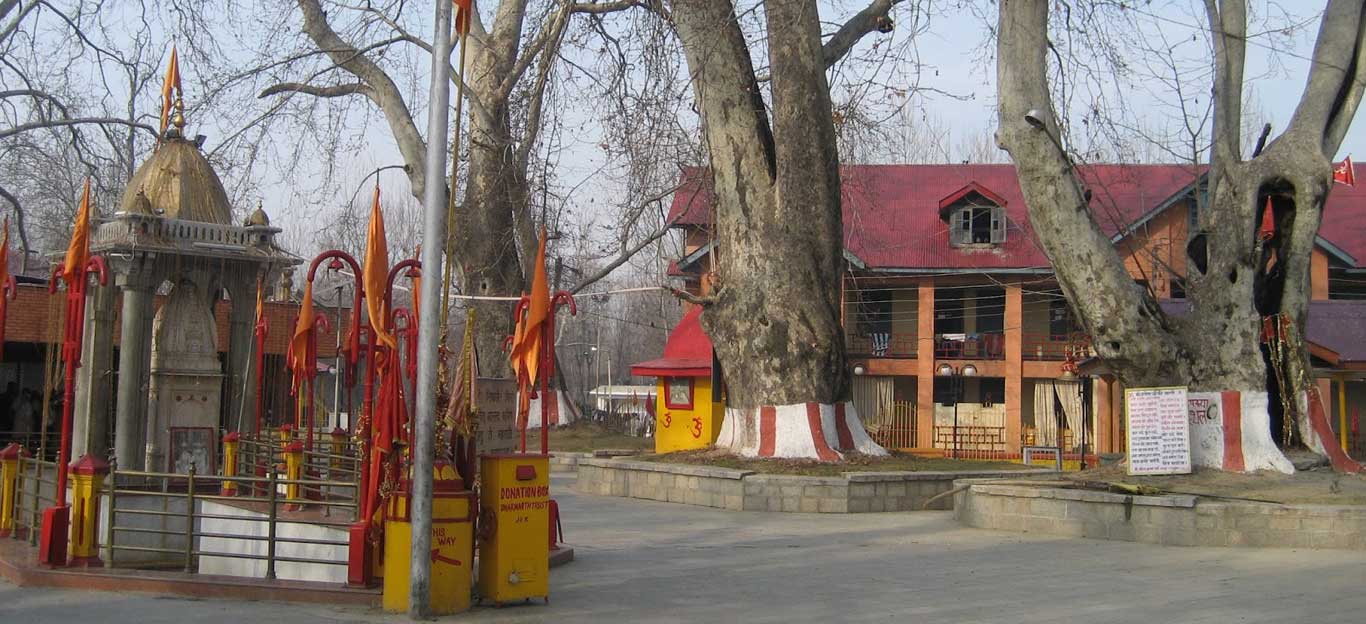
As the boat moves down, the mountain peaks in the east -Mahadiv, Kotwal and Harmoukh stand out conspicuously. There are lovely, shady, chinar groves where the boat can be moored for some time. One of these is Naran Bagh opposite Shadipor where the Sind enters the Vetasta (Jhelum) fom the Gangabal lakes. In the middle of the river is an islet shaded by a dwarf chinar. This is a holy spot called Prayag and is a miniature representation of the Prayag (Allahabad) of the Plains. Thousands of pilgrims gather here in boats when there are ten stellar combinations. There is a waterway from here to the Khirbhawani spring which is worth a visit. The occasional changes in the colour of the water of the spring invest the Hindu shrine with mystic sanctity in the eyes of its votaries.

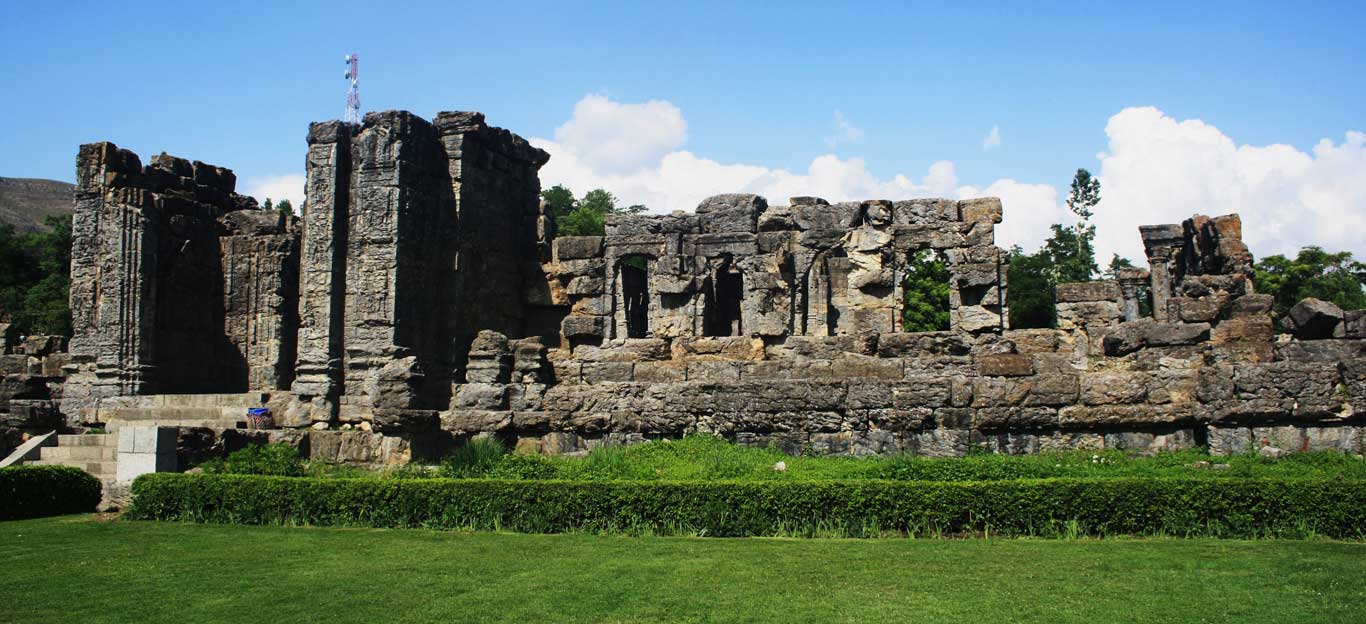
About two miles from Shadipor on the alluvial plateaus of Paraspor and Divar are the remains of old temples and other shrines dedicated to Vishnu, Buddha and Shiva and built by the renowned king Lalitaditya, his queens and ministers in the heyday of their glory, about A.D 700. They contained gold, silver and copper images of enormous value. A stone minaret 54 ft. high with the bird Garuda resting on its top served as a flag. The enormous size of the stones in these ruins and the exquisiteness of their dressing and finish, strike the onlooker with wonder. A graphic account of these buildings is given in 'Ancient Monuments of Kashmir' on pages 146-149. The course of the Vetasta then lay along the side of the plateau. It was afterwards diverted by the great engineer Suya in Avantivarman's reign (A.D. 855-883). Shadipor, which was founded by Sultan Shab-ud-Din (1337-1354), is one of the important fishing centres. Fishermen in small boats sweep the river with various kinds of nets. The fish belong to the following varieties:

(1) Chhriw has a dark spotted back, white belly and a large pointed mouth. Some of these weigh more than 12 lb.
(2) Sattar Gad has also spots of various colours and white sides.
(3) Ail Gad is black in colour.
(4) Chesh Gad has a small mouth and is white in colour.
(5) Rama Gurun is a small fish with black bars on its back.
(6) Anyur.
(7) Rupit Gad.
(8) Parim Gad (Mirror Carp).
The fish of the Sind are prized more than those of the Jhelum. It is said that the best fish are found at the time of the rape-seed blossom and near those fields. Probably the reason is that the reflection of the yellow blossom falling in the river attracts the fish. Sumbal is the next important village. Just outside the village on the river bank are some huge chinars and an elm, enclosed by a wall. This spot is sacred to the Hindus and dedicated to Nanda-ki-shuwar. A temple has been lately built there. The Gilgit Road passes through the village. A little lower down the water from the Manasbal Lake flows through the canal which is its only outlet into the Jhelum. There is a small village over this canal. A close examination of the masonry walls supporting the bridge on either side leaves little doubt as to the existence of temples in the ancient time on the shores of the lake. In these walls are seen stone images which must undoubtedly have adorned some Buddhist temples.

The boat is towed or punted up the canal shaded with willow to the mouth of the lake. Herons, starlings and frogs are seen in the fields. When the water of the river is high, the peasants dam the water at the bridge, to save their fields from inundation.

There are two camping sites on the shore of the lake. One is near the ruined Moghul Garden built by Nur Jahan, as the local peasants say. This is called Garoka or Joroga, which means a bay window. It signifies a royal mansion with a highly ornamented and artistically built pavilion, with a seat on the window for the Mughul queen, from which she could survey the charming lake. It is possible that Aha Teng (6,256 ft.) the hillock bordering the lake in the south was in those days clothed with groves of cypress, the most favourite garden tree Of the Moghul monarchs. There are four terrace, at the foot of the ruined wall. One is practically silted up. The Government might with profit restore this site, lay out a garden or build a rest-house in it. Here can be seen a big chinar tree and a slab of stone belonging to some old temple. When the water of the lake is very low a submerged temple can be seen roofed like a quadrangular prism. The other encampment site stands at the farther end of the lake under chinars known as Padshah Boni (Royal Chinars). This is one of the best camping sites in Kashmir. This spot is also called QozBagh having probably been planted by the Moghul judge. A canal taken from Sind by the great king of Kashmir popularly known as Bad Shah (A.D. 142I-1472) irrigates the alluvial plateau of Safapor. Close by is a cave, dug by a fakir whose grave lies just outside it, near a small shrine. He came from India and married a Kashmiri girl. The soil is sandy and this may lead to the cave being closed one day. There is a tourist hut here.

The northern and eastern shores of the lake are riddled with springs and covered with watercress. On the southeastern side a stream from the Sind enters into the lake. There appears a fissure right in the middle of the lake running east to west. It is said that the Soma plant from which the ancient Aryans extracted a juice which they offered to their gods and drank themselves, grew profusely round the shore of this lake.

On the north-east of the lake there is a village called KondaBal (Kiln Place). This village owes its existence to a quarry from which stones are sent to Srinagar. The stones are burnt for lime. The pebbles are preferred for macadamised roads and are known as manasbal rod. It is an excellent site for founding a cement factory.

What a pleasure is a cruise on the lake! The land shelf (submerged bank) is covered with various kinds of pond-weed, Naais Maor and water milfoil in which fish are seen darting about. As the boat moves outwards the colour becomes turf green, perfectly weedless and refreshing to the vision. The high mountain wall which surrounds the lake renders tranquillity impregnable to all external disturbing forces. The air breathes peace and the care-worn heart is soothed. The delight of diving and bathing as experienced here beggar description.

Fishermen are often seen standing on the prows of their light boats, their eyes scanning the depths of the lake for fish and their hands holding a spear with which to strike and catch the fish. Sometimes one may see a hook and line used for this purpose. The line is about 1,000 yards long and a hook with a weight is placed after every yard, a small fish being used as a bait. After two days the line is taken out and the fishes are captured. We took soundings at five places and the depth was between 30 and 40 feet, but in some places it must be much more.

It is worth while to attempt a climb, if not to the top of Krosh Peak, which is used as a station by the survey party of India and stands at a height of 10,300 ft. above sea level, at least to lower heights from where the finest sights in the world burst into view.

The ascent begins from the Manasbal Gap. The spur is devoid of trees but the gems of Nature raise their heads among the rocks and on gravelly paths. The conspicuous flower is the Eremurus himalaicus with radical leaves and white flowers on a stout raceme. Beds of iris and Kashmir tulips decorate the path. The higher one climbs the more attractive becomes the panorama. The valley unrolls, like a cinema reel, scene after scene of the rarest beauty before the spectator.

In front of him rises the Pantsal Barrier with its flat top covered with dazzling snow, the peaks of the range, Tatakoti, Romesh-Thong (Sunset Peak) Brahma Shakar, all over 15,000 ft., project like crystal cones draped in silver sheets. The forest-clad slopes are seen steeped in sombre light and the dark shades of blue which play on them are beyond the power of pen to describe. On the far east we see Nun-Khun over 23,000 ft., and Gwashi-Brari, above 18,000 ft., towering giants which appear to stand sentinel on the valley. The whole place spreads out like a chequered carpet of patches of green and yellow, standing against the silver expanse of the Wular, the Anchar and the other lakes, while the Harwan Reservoir twinkles like a star in the Eastern corner. The majestic sinuous flow of the Vetasta (Jhelum) emptying itself into the Wular and flowing out towards Sopor adds greatly to the beauty of the valley.

The greater part of the valley appears covered with water which lends support to the view that Kashmir was once a lake.

Higher up the climbing is over rocks and one has to be rather sure-footed to reach the top of the peak. It is possible to have snow near the summit-which is crowned with a cluster of fir trees-as late as early May. Patches of Saxifraga ligulata and Corydalis rutaefolia variegate the landscape here. This climb should always be tried in the early part of the day. The essential equipment should include water, carried in bags or bottles. On one occasion we assembled with the boys and we offered a prayer for the peace of the world.

Close to Krosh Peak is another peak called Halder where there is a rock underneath which water is flowing every year, on Niijala Ekadashi day a fair is held here. According to Pt. Anand Koul, the pilgrims sing in one chorus.

Balbhadro Haldaro Palah ulah poni trav

O Balabhadra Haldara (Lord Krishna's elder brother) allow water to flow out from under this rock.

Then suddenly water flows out in a large volume from underneath this rock which suffices for bathing of the pilgrims assembled.

A tourist who has not much time to spare can pay a flying visit to the lake in a car. I suggest the route, Srinagar via Shadipor, crossing the bridge of Sumbal and leaving the car on the eastern shore of the lake under the Padshah chinar; where he can have his breakfast. He can then hire a boat from a fisherman and have his lunch under the chinar at Jaroga Moghut garden. Next he can drive his car through the fields, and the cherry and apple gardens and have his tea at Nasim Bagh on the Dal Lake watching the whiskered terns skimming along the surface of the water and return for supper to his hotel or camp.

With his base camp at Manasbal a tourist may make excursions as follows:

1. Khirbhawani about six miles. The famous spring changes colour occasionally and is sacred to Hindus.
2. Manasbal to Kangan, 16 miles; Kangan to Gund, 13 miles; Gund to Sonamarg, 14 miles. A car now runs direct to Sonamarg.
3. Manasbal to Rama Radan, via Vusan (not a good camping ground); Rama Radan to Malish, climb to Bharat Bal, about six hours (start early); Malish to Gangabal, about three hours along the meadow; Gangabal to Wangath, 12 miles; Wangath to Ganderbal, 13 miles. (Consult The Beautiful Valleys of Kashmir and Ladakh).
4. To the sulphur spring near the road, not far from Ajus.
5. Manasbal Erin Valley. Manasbal to Nod-hal; Nod-hal to Kiud-or; Kiud-or to Sar-bal lakes.

Kashmiri Overseas Association
Srinagar & its Environs