
MOUNTAIN CLIMBS

1. Shankarachar Hill.

2. The Zabarwon Peak.

Start early from Aita Gaji Gap outside the fence through almond gardens. The footpath is good. The ascent is gradual. Higher up, the path enters a belt of pines which ends on the summit. The path along the ridge to the twin peaks has several steep descents and ascents. The ravines are thickly covered with witch-hazel trees where occasionally a black bear may be encountered. Antelopes sometimes may be seen. To avoid the thorn bushes, the path which leads down the twin peak spur should be followed right up to Chashma-i-Shihi.

3. Twin Peaks

Start at 7 a.m. from Chashma-i-Shahi. Go along the path to the foot of the hill. Avoid thorns on the right. Follow the path. As you ascend higher and higher the valley opens, you see the mountain range and the plain below bathed in sunlight. Have your lunch at the summit and return to have tea at Chashma-i-Shahi. The whole range is a Reserve.

4. Mahadiv

It is possible to do the climb in one day. Drive to Harwan. Start at 6 a.m. Dwara is the last village. There is a hut at Dwara Won where a bridge crosses the stream. It is possible to get milk here. Another hut is at Nila Pantsil. Bobian is five miles from Dwara and Ledwas (10,500 ft.) is five miles from Bobjan. Ledwas is a meadow. Here are five or six temporary sheds of Gujars in the middle valley ascent to the col. From here go along the lower slope of the ridge over the boulders and you will reach the summit (13,013 ft.) hours. The view of the mountain ranges in six or seven hours. The view of the mountain ranges stretching in front is magnificent. Among the boulders in the grassy spots rich floral vegetation grows. The Macrotomia Benthami, the wild rhubarb, the Allim, Hedysarum cacherianum, the Jurnea macrocephela and many other varieties are common. Griffon vultures may be seen hovering round the peaks. The peaks may be attempted by the southern side also. The descent may take three to four hours, depending on the speed of the trekker.

There are some other peaks which can be attempted but they will take seven to ten days.

1. Romesh Thong (The Sunset Peak) (15,000 ft.)
2. Tata Koti (15,645 ft.)
3. Harmoukh (16,842 ft.)
4. Kolahoi (17,779 ft.)

A Mahadiv Climb

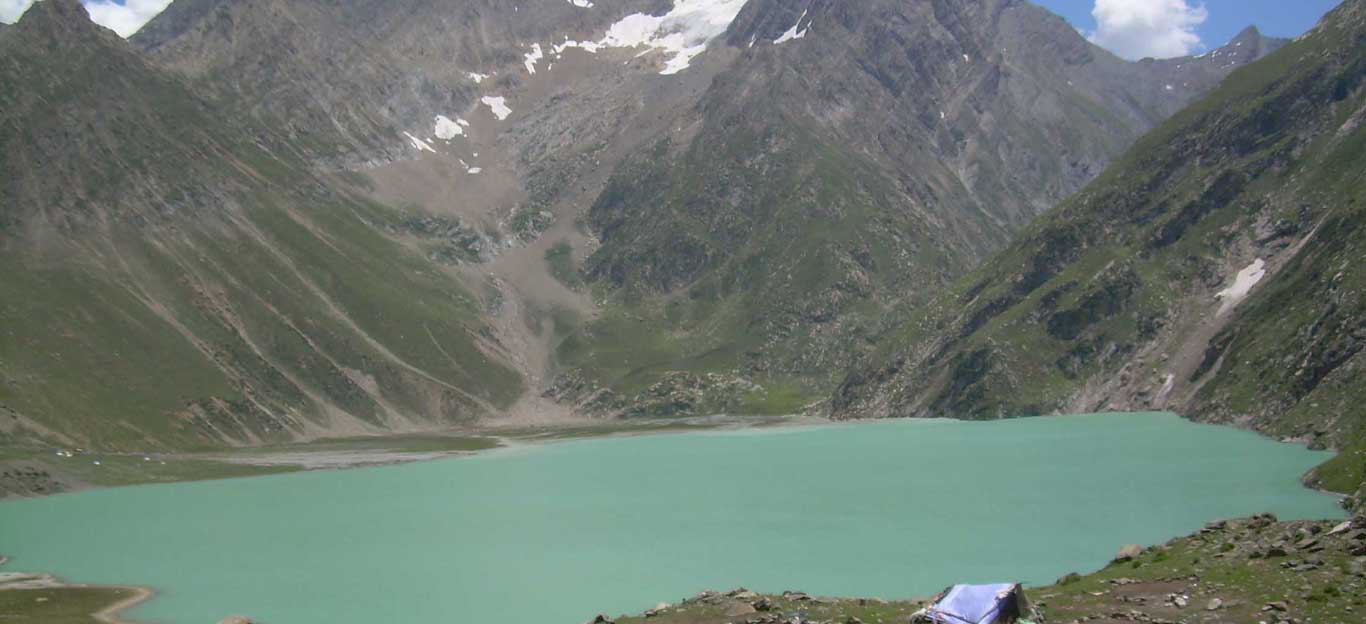
Mahadiv (13,013 ft.) is a conspicuous peak to the north-east of Srinagar overlooking the Dal Lake. An isolated spur towards the south about 12,000 ft. high is the sacred spot which is visited by Hindu pilgrims on the full moon day in August, which is also the day when pilgrims worship in the Amar Nath Cave. A grand view can be obtained from summit of all the higher peaks of the mountain ranges which encompass the valley - on the east Kolahoi and Nun Khun; on the south and west the Brahma Shakri, Romesh Thong and Tatakoti; on the north, Nanga and Harmoukh; while the valley is set among the surrounding mountain ranges like an emerald slab fretted with silvery sheets and streaks of lakes and rivers and embossed with the amber of and portions. Alluvial plateaus are spread beneath these ranges.

The climb of Mahadiv can be performed in one day, two days or three days. The main secret of reducing the difficulties of the climb to a minimum is to start ealy-about 6 a.m. from Dwara. Arrangements for coolies should be made beforehand from Harwan village and they should be told to meet either at Farm Bagh or at Shalamar. He who aims at climbing to the summit in one day should take a coolie carrying all his foodstuff with him, while he who attempts it in two or three days must carry a light tent and pitch it at Ledwas. He should also carry all necessaries except firewood.

Dwara is about 800 ft. higher than Srinagar and is 14 miles away. One can drive up to the Farm Bagh which is full of Spanish chestnuts, apples, pseudo-acacia, cherry and other fruit trees and is a good camping ground outside the New Thid. It would be a pleasant trip by boat to Shalamar, where coolies, to be arranged beforehand, should be told to meet. On both sides of the road from Shalamar to Dwara there are paddy-fields which in some places are in terrace-formation. Orioles, thrushes, ring doves and shrikes are heard warbling on the trees while the bulbul with its grey crest and yellow vent is seen flitting along the roadside.

The path from Dwara passes through a close defile, by the right bank of the stream, carving cascades and pools round which whistling thrushes, redstarts and occasionally forktails catch, their prey above the spray. From the bush-covered slopes of the mountains are heard the notes of the bush chat and pale bush warblers. The guelder (Kulim) whose lovely blossoms adorn the early spring) the hazel (virin), the ash, the maple, the wild walnut and the chestnut are some of the trees which shade the path. About three miles from Dwara is Dirawon where the path passes a bridge and there is a Gujar hut. It is pleasant to breakfast here. At Nila Pantsal there is another hut. Some ravines retain snow throughout the whole year and this is taken by coolies to various hotels for the preparation of cool drinks in summer months. There of four temporary huts at Bobjen (7,500 ft.) on the is a hamlet left bank of the stream. There we see a large variety of Alpine flowers. Cynoglossum and Mentha selvestris are in profusion. This place is about six miles from Dwara. The ascent from here is moderately steep and pines clothe the mountain side till we reach Ledwas which is the corrupt form of Rudrawas (11,000 ft.) which is ten miles from Dwara and takes about five or six hours to reach. It is from here that the birch and Rhododendron campanulatum show their heads. The flowers of the latter are dried and used as snuff for bad colds.

Here we come across five or six temporary sheds of Gujars who migrate here for the summer months. Sites for pitching tents under pines are clearly marked.

Ledwas

Ledwas is a meadow where Alpine flowers rear their heads. As soon as the snow thaws the primulas burst into blossom. The buttercups and pedicularis are met with in plenty. Sometimes even in early June the valleys are covered with snow. There are three valleys leading to the highest peak. To gain the summit the usual way is to go up the middle valley leading up to the middle pass - Wover Gol (Weaver's Pass) being flanked by a ridge and being marked by many ascents and descents dotted with boulders. Among these boulders, the wild rhubarb, the Allium (wan pran) the borage, Macrotomia Benthami, Fritillery Royleana, Androsia and Sedum may be found. It is possible to attempt the peak from the south. The glorious view which unrolls before the conqueror of the peak is an ample reward for his strenuous climb. If time is of no importance in descending one may spend a night at Ledwas, or if he is in a hurry, it will take hime five or six hours to reach Shalamar.
Kashmiri Overseas Association
Srinagar & its Environs